
Unlimited Streaming
Listen to this album in high quality now on our apps
Start my trial period and start listening to this albumEnjoy this album on Qobuz apps with your subscription
SubscribeEnjoy this album on Qobuz apps with your subscription
Digital Download
Purchase and download this album in a wide variety of formats depending on your needs.
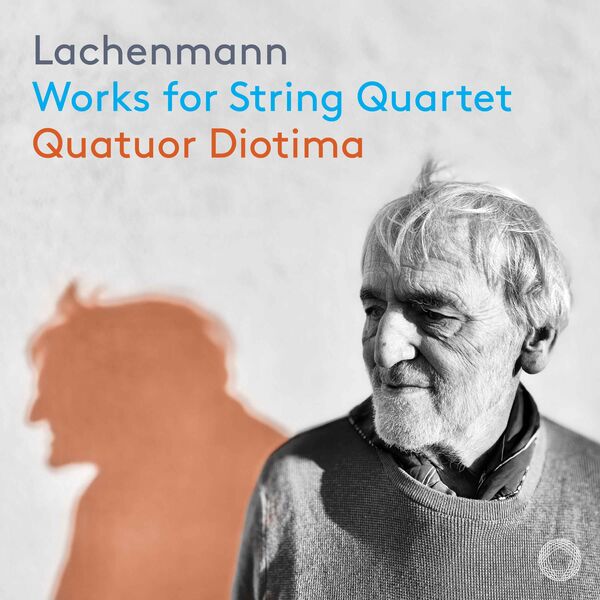
While German experimental composer Helmut Lachenmann is a pianist, his three string quartets are some of his best-known and most frequently recorded works. Quatuor Diotima's new recording, Lachenmann: Works for String Quartet, provides a subtly new perspective which flatters the group's excellent performances.
The 89-year-old composer writes rigorous pieces that focus on texture and sound over conventional melody, harmony, or meter. Performers interact with instruments through an array of extended techniques that minimally evoke an instrument's conventional palette. His compositions evolve continuously, with deep intellectual rigor but few hooks to pull the listener into the morphing field of sounds.
Lachenmann wrote his initial string quartet, "No. 1, Gran Torso" in 1971, and it pushes even further than, for example, Xenakis's "ST-4/1,080262" from a decade earlier. Where the Xenakis piece weaves together conventionally pitched sounds and jarring textures, "Gran Torso" builds its throughline solely through its array of radical, creative sounds. Two more string quartets, "No. 2, Reigen seliger Geister" from 1989 and "No. 3, Grido" from 2001, follow similar approaches to texture and structure.
Recording these three works has become a showpiece for string quartets to exhibit their skill with demanding, experimental music. Both Arditti Quartet and JACK Quartet have taken relatively traditional approaches to capturing their instruments with room and space. In contrast, Quatuor Diotima recorded their scraping and scratching sounds with an intimacy that's more common in experimental jazz and improvised music. The unusual textures feel incredibly present and close, without the sense of surrounding air that's associated with a standard string quartet recording.
The stark sounds that Lachenmann has written are perceptible with an intimate detail that the earlier recordings did not seek. Quatuor Diotima, who has worked closely with Lachenmann in the past, clearly understands the level of precision needed for this technical approach to succeed and perform with clarity. Works for String Quartet emphasizes the overt modernity of these pieces, without abandoning their place in the string quartet tradition. © Steve Silverstein/Qobuz


You are currently listening to samples.
Listen to over 100 million songs with an unlimited streaming plan.
From £10.83/month
Quatuor Diotima, MainArtist, MusicalEnsemble - Helmut Lachenmann, Composer - Michael Havenstein, Producer
2025 PENTATONE Music B.V. 2025 Association Les Diotima
Quatuor Diotima, MainArtist, MusicalEnsemble - Helmut Lachenmann, Composer - Michael Havenstein, Producer
2025 PENTATONE Music B.V. 2025 Association Les Diotima
Quatuor Diotima, MainArtist, MusicalEnsemble - Helmut Lachenmann, Composer - Michael Havenstein, Producer
2025 PENTATONE Music B.V. 2025 Association Les Diotima
Review: Quatuor Diotima - Lachenmann: Works for String Quartet
While German experimental composer Helmut Lachenmann is a pianist, his three string quartets are some of his best-known and most frequently recorded works. Quatuor Diotima's new recording, Lachenmann: Works for String Quartet, provides a subtly new perspective which flatters the group's excellent performances.
The 89-year-old composer writes rigorous pieces that focus on texture and sound over conventional melody, harmony, or meter. Performers interact with instruments through an array of extended techniques that minimally evoke an instrument's conventional palette. His compositions evolve continuously, with deep intellectual rigor but few hooks to pull the listener into the morphing field of sounds.
Lachenmann wrote his initial string quartet, "No. 1, Gran Torso" in 1971, and it pushes even further than, for example, Xenakis's "ST-4/1,080262" from a decade earlier. Where the Xenakis piece weaves together conventionally pitched sounds and jarring textures, "Gran Torso" builds its throughline solely through its array of radical, creative sounds. Two more string quartets, "No. 2, Reigen seliger Geister" from 1989 and "No. 3, Grido" from 2001, follow similar approaches to texture and structure.
Recording these three works has become a showpiece for string quartets to exhibit their skill with demanding, experimental music. Both Arditti Quartet and JACK Quartet have taken relatively traditional approaches to capturing their instruments with room and space. In contrast, Quatuor Diotima recorded their scraping and scratching sounds with an intimacy that's more common in experimental jazz and improvised music. The unusual textures feel incredibly present and close, without the sense of surrounding air that's associated with a standard string quartet recording.
The stark sounds that Lachenmann has written are perceptible with an intimate detail that the earlier recordings did not seek. Quatuor Diotima, who has worked closely with Lachenmann in the past, clearly understands the level of precision needed for this technical approach to succeed and perform with clarity. Works for String Quartet emphasizes the overt modernity of these pieces, without abandoning their place in the string quartet tradition. © Steve Silverstein/Qobuz
About the album
- 1 disc(s) - 3 track(s)
- Total length: 01:09:36
- 1 Digital booklet
- Main artists: Quatuor Diotima
- Composer: Helmut Lachenmann
- Label: PENTATONE
- Genre: Classical Chamber Music Quartets
2025 PENTATONE Music B.V. 2025 Association Les Diotima
Distinctions:
Improve album information
 Why buy on Qobuz...
-
Stream or download your music
Buy an album or an individual track. Or listen to our entire catalogue with our high-quality unlimited streaming subscriptions.
-
Zero DRM
The downloaded files belong to you, without any usage limit. You can download them as many times as you like.
-
Choose the format best suited for you
Download your purchases in a wide variety of formats (FLAC, ALAC, WAV, AIFF...) depending on your needs.
-
Listen to your purchases on our apps
Download the Qobuz apps for smartphones, tablets and computers, and listen to your purchases wherever you go.